French sentiment, solved.
Turn every review into Positive, Neutral, or Negative—instantly and at scale.

Turn every review into Positive, Neutral, or Negative—instantly and at scale.
AI sentiment analysis turns free‑form text into a simple label and a probability score. In French, that’s harder than it looks.
French reviews appear in many tones and channels. Irony, soft negatives, and idioms like “pas mal” or “bof” make intent ambiguous across marketplaces, storefronts, apps, social posts, and helpdesk threads. Whether you choose the Dataset (to train/adapt) or the Model (to score immediately), you deploy French‑native AI sentiment classification that tags each review as Negative / Neutral / Positive—consistently—so dashboards, routing, and alerts all use the same KPI you can trust and automate.
Deploy the AI model to score immediately, or train your own model from the Dataset to adapt behavior. Either way, you enable a shared, French‑native 3‑class sentiment KPI across teams and systems.
1
Prioritize negative first, monitor neutral, acknowledge positive. Escalate automatically when sentiment and key terms (refund, delay, broken) co‑occur.
2
Track the share of positive/neutral/negative by brand, category, or channel, and compare before/after after releases or policy changes.
3
Drive rules and alerts locally (on‑prem), keep data private, and avoid per‑call surprises.
French-native from the start: the classifier is fine-tuned on CamemBERT v2 and validated on a stratified hold-out with macro-F1 so each class matters equally. It runs on-prem or private cloud on CPU or GPU, and can be exported to ONNX when you need lower latency. Privacy is default—no data leaves your environment—and you can later lift accuracy in your domain by fine-tuning with the JSONL dataset provided.
Feed in raw French review text and the AI model (or a model you’ve trained from the dataset) returns Negative / Neutral / Positive with calibrated probabilities. You set a threshold to decide what gets escalated, published, or watched. Every prediction can be logged to your warehouse for monitoring, reports, and simple drift checks as volumes or channels change.
Teams that need one simple KPI everyone can use. Support gets a fair triage signal and clear escalation rules; E-commerce & Product see the before/after impact of releases on real customer language; Data/IT keep control with open, inspectable artifacts instead of a black-box API, and deploy in the same stack they already operate.
Choose the Dataset to train and adapt: line-delimited JSONL with labels, an exact id↔label mapping, an 85/15 split recipe and an evaluation template, plus checksums and docs. Choose the Model to ship now: fine-tuned weights, tokenizer, the same mapping, and quickstart scripts (Transformers) so you can score in batch, stream, or behind an internal endpoint—both options designed to coexist.
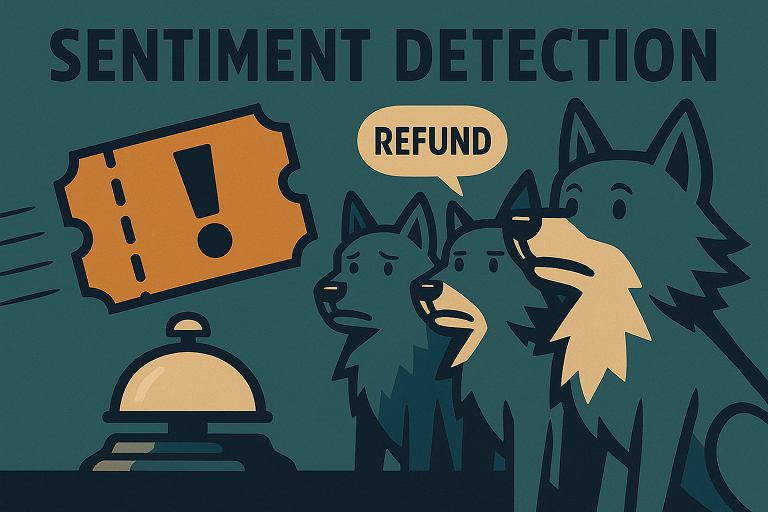
Negative sentiments associated with keywords related to refunds trigger the creation of a high-priority ticket and the sending of an alert to the appropriate queue.
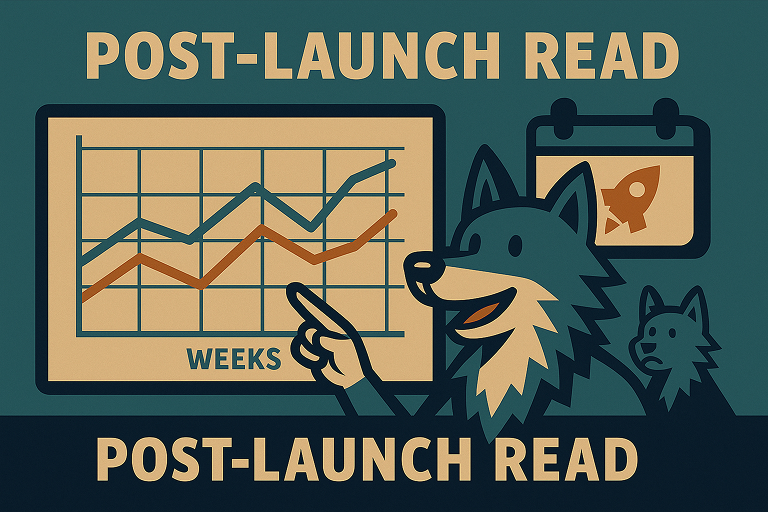
Weekly variations in positive/neutral/negative reviews allow you to visualize the impact of a new application version within a few days.

A monthly summary shows the share of each category by brand and channel, easy to read and use for reporting purposes.
Two ways to use French‑native sentiment.
Same 3‑class output; choose your level of control.
€50
Best when you need results now, on‑prem or private cloud.
Includes
Delivery
€300
Best when you want to train, adapt, and audit.
Includes
text, sentiment)Delivery
You can choose between the following solutions:
Dataset: JSONL with text and sentiment (negative, neutral, positive), plus documentation (schema, splits, label mapping, evaluation template).
Model: CamemBERT v2–based 3‑class classifier with weights, tokenizer, and label mapping; ready for Hugging Face pipelines.
We track macro‑F1 on a stratified hold‑out split and can share an evaluation report on request. Performance varies by domain (short app reviews vs. detailed complaints), but the goal is not a novelty score—it’s a consistently interpretable signal you can operationalize. If you bring domain‑specific data, fine‑tuning can lift performance on your edge cases.
Yes. Both dataset and model are designed for on‑prem or private cloud. The model runs with Hugging Face Transformers on CPU or GPU. For extra speed, ONNX export is supported.
It’s French‑native and focused on just three classes—the categories stakeholders already use. You keep control (adapt it), enjoy predictable costs (no per‑call surprises), and maintain privacy (no external data sharing). In practice, that means fewer misses on idioms and a simpler KPI.
Yes. The model can be fine-tuned again with a fine adjustment of your field of activity. Even a few thousand high-quality examples from your field can make a significant difference. We provide a pragmatic plan (data selection, distribution discipline, quality controls) that you can follow to train the model to your data.
Yes. The dataset uses line‑delimited JSON (JSONL)—friendly for data warehouses and stream processing. Each line contains text and a sentiment label. The schema is intentionally minimal so it’s easy to map to your tables and BI tools.
We version both dataset and model, document normalization rules, and keep the schema stable. Evaluations are repeatable with a recommended 85/15 stratified split. We also share practical guidance for drift checks and threshold updates.

Instant clarity for French customer feedback.
Deploy the model to evaluate reviews immediately, or use the dataset to tailor sentiment to your domain.
Start small, then refine as you grow.